Wednesday, September 8, 2010

JavaFX Script: Dynamic Java Scripting for Rich Internet/Client-side Applications


The highly anticipated JavaFX™ technology and platform, including the latest version 1.2 update, is essentially Sun’s approach to Adobe Flash and Microsoft’s emerging Silverlight. JavaFX lets developers play with the open source scripting, desktop, and mobile APIs offered to create dynamic, seamless visual user interfaces (UIs) that are “Flash–like” and beyond…
Learn from bestselling JavaFX author Jim Weaver and expert JavaFX developers Weiqi Gao, Stephen Chin, and Dean Iverson to discover the highly anticipated JavaFX technology and platform that enables developers and designers to create RIAs that can run across diverse devices. Covering the JavaFX Script language, JavaFX Mobile, and development tools, Pro JavaFX™ Platform: Script, Desktop and Mobile RIA with Java™ Technology is the first book tha fully provides JavaFX version 1.2 code examples that cover virtually every language and API feature.
This book contains the following:
  • Tutorials that teach JavaFX 1.2 to an application developer or graphics designer who has had no exposure to JavaFX. These tutorials will be exhaustive, covering virtually every facet of JavaFX Script and are fully updated for the JavaFX 1.2 release.
  • Reference materials on JavaFX 1.2 that augment what is available from the JavaFX 1.2 Language Reference and API documentation.
  • How to take JavaFX 1.2 to other platforms besides the desktop, such as mobile.

J2ME - The Complete Reference


Java developers, here's your chance to survey the scope of J2ME (Java 2 Micro Edition) knowledge in one solidly written reference. Discover the basic architecture and functionality of J2ME and how it differs from J2SE and J2EE. Build a J2ME database with coverage of essentials such as commands, items, event processing, and low- and high-level display interfaces. Learn the advanced aspects of mobile development--plus, get in-depth coverage of security, Web services, information management, and storage. Whatever your experience level, J2ME: The Complete Reference is your essential one-stop resource for understanding and utilizing J2ME to build mobile applications and services.
  • Understand the organization, configurations, and profiles of J2ME, including the new PIM API
  • Review small computing technology, including wireless, mobile radio networks, PDAs, and more
  • Navigate J2ME architecture and the development environment
  • Limit memory use, simplify user interface, minimize network traffic, and use best practices
  • Write, record, sort, read, search, and store records
  • Manage data and understand database concepts
  • Anticipate mobile application uses for Web services, information management, and other key functions
  • Work with HTTP connections, and networking and Web services 

J2ME in a Nutshell (O'Reilly Java)


J2ME in a Nutshell provides a solid, no-nonsense reference to the "alphabet soup" of micro edition programming, covering the CLDC, CDC, KVM and MIDP APIs. The book also includes tutorials for the CLDC, KVM, MIDP and MIDlets, MIDlet user interfaces, networking and storage, and advice on programming small handhelds. Combined with O'Reilly's classic quick reference to all the core micro-edition APIs, this is the one book that will take you from curiosity to code with no frustrating frills in between.

Programming Wireless Devices with the Java(TM)2 Platform, Micro Edition (2nd Edition)


This book presents the JavaaA A 2 Platform, Micro Edition (J2MEaA A ) standards that support the development of applications for consumer devices such as mobile phones, two-way pagers, and wireless personal organizers. To create these standards, Sun collaborated with such consumer device companies as Motorola, Nokia, NTT DoCoMo, Research In Motion, Samsung, Siemens, Sony Ericsson, and many others. The result is a highly portable, small-footprint application development environment that brings the unique capabilities of Java technology, including platform independence and enhanced security, to the rapidly growing wireless market. This definitive JavaaA A Series guide provides a programmer's introduction to the Java 2 Platform, Micro Edition. It presents a general description of wireless technology and an overview of the J2ME platform. In addition, the book details the Connected Limited Device Configuration (CLDC) version 1.1 and the Mobile Information Device Profile (MIDP) version 2.0, the standards that define the Java platform features and libraries for wireless, resource-constrained devices.Written by a team of authors that includes the original J2ME technology experts from Sun, Motorola, and Nokia, this book provides a description of the Java 2 Platform, Micro Edition, as well as practical implementation advice. The JavaaA A Series is supported, endorsed, and authored by the creators of the Java technology at Sun Microsystems, Inc. It is the official place to go for complete, expert, and definitive information on Java technology. The books in this Series provide the inside information you need to build effective, robust, and portable applications and applets. The Series is an indispensable resource for anyone targeting the JavaaA A 2 platform.

Micro Java(TM) Game Development


Micro Java Games Development explains game development for devices that support J2ME MIDP. The six parts cover a full range of topics, from a tour of all available micro-devices (Palms, cell phones and pagers), a discussion of software standards apart from J2ME (cell phones, messaging, I-mode and wireless enhancements such as Bluetooth), and available J2ME extensions (Siemans, Ericcson, Nokia), development tools and restrictions, to the creation of a meaty J2ME game!

Hibernate Quickly


A concise introduction to Hibernate's many configuration and design options, this book distills Hibernate into digestible pieces with many code examples, practical usage scenarios, and coverage of the tools available to developers writing Hibernate applications. Developers will learn what Hibernate is, what it can do, and how it can be used effectively. New Hibernate features are covered and the provided code examples evolve incrementally as new concepts are introduced. The examples included execute from Ant and run as JUnit test cases. An understanding of JUnit is not required and running the code as a series of test cases allows for the easily demonstrated functionality without resorting to a complicated Web application. How Hibernate can work with other common development tools and frameworks like XDoclet, Struts, Webwork, Spring, and Tapestry is also discussed as well as writing mapping files and creating associations.

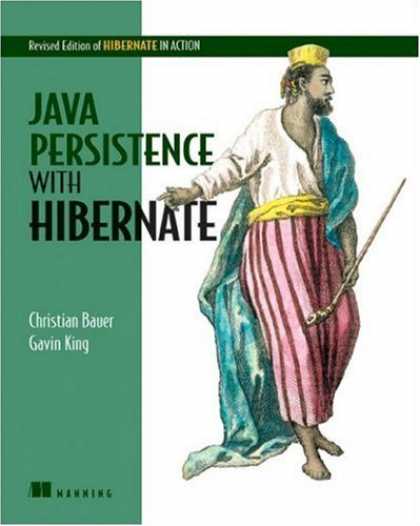
Java Persistence with Hibernate


Java Persistence with Hibernate is considerably more than simply a second edition to Hibernate in Action. It provides a comprehensive overview of all the capabilities of the Java Persistence API in addition to those of Hibernate 3, as well as a detailed comparative analysis of the two. It describes how Hibernate has been used to implement the Java Persistence standard, and how to leverage the Hibernate extensions to Java Persistence.
-- From the Forward by LINDA DEMICHIEL Specification Lead, Enterprise JavaBeans 3.0 and Java Persistence Sun Microsystems
Persistence, the ability of data to outlive an instance of a program, is central to modern applications. Hibernate, the most popular Java persistence tool, provides automatic and transparent object/relational mapping so it's a snap to work with SQL databases in Java applications. Hibernate conforms to the new EJB 3.0 and Java Persistence 1.0 standards.
Java Persistence with Hibernate explores Hibernate by developing an application that ties together hundreds of individual examples. You'll immediately dig into the rich programming model of Hibernate 3.2 and Java Persistence, working through queries, fetching strategies, caching, transactions, conversations, and more. You'll also appreciate the well-illustrated discussion of best practices in database design, object/relational mapping, and optimization techniques.
In this 2nd edition of Manning's bestselling Hibernate in Action, authors Christian Bauer and Gavin King -- the founder of the Hibernate project -- cover Hibernate 3.2 in detail along with the EJB 3.0 and Java Persistence 1.0 standards.