Monday, September 13, 2010
Mastering Enterprise JavaBeans 3.0
By: Rima Patel Sriganesh Gerald Brose Micah Silverman
ISBN: 0471785415
Publisher: Wiley - 2006-07-12
Paperback | 685 Pages | List Price: $45.00 (USD) | Sales Rank: 283804
An invaluable tutorial on the dramatic changes to Enterprise JavaBeans (EJB) 3.0
Featuring myriad changes from its previous versions, EJB 3.0 boasts a very different programming and deployment model, with nearly every aspect of development affected. Even the most experienced EBJ and J2EE developers will need to relearn how to best use EJB to develop mission-critical applications. This author team of experts has taken their combined skills in architecture, development, consulting, and knowledge transfer to explain the various changes to EJB 3.0 as well as the rationale behind these changes. You'll learn the concepts and techniques for authoring distributed, enterprise components in Java from the ground up.
Covering basic through advanced subjects, Mastering Enterprise JavaBeans 3.0 is more than 50 percent new and revised. Four new chapters and one new appendix cover the latest features of this new release, and in-depth coverage of the Java Persistence API and the entities defined therein is provided. The authors' main goal is to get you programming with EJB immediately. To that end, you'll learn:
How to implement EJB 3.0 beans, with emphasis on session beans (stateful and stateless) and message-driven beans
Both basic and advanced concepts (such as inheritance, relationships, and so on) of Java Persistence API defined entities
How to develop and deploy EJB 3.0 Web services
How to secure EJB applications
How to integrate EJB applications with the outside world via the Java EE Connector technology
Tips and techniques for designing and deploying EJB for better performance
How clustering in large-scale EJB systems works
Best practices for EJB application design, development, and testing
Wednesday, September 8, 2010
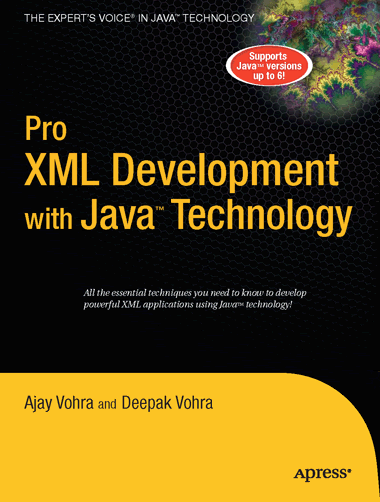
Pro XML Development with Java Technology
Pro XML Development with Java Technology has been written to help you, the professional Java developer who needs a practical hands-on guide to marrying these technologies together effectively. There are a lot of books out there, but none really explore the combination deeply, and they are largely theoretical. The main objective here was to consolidate the theory and practice of XML and Java technologies in a single, up-to-date source, that is firmly grounded in underlying XML concepts, and can be consulted time and again to rapidly speed up enterprise application development!
It covers all the essential XML topics, including XML Schemas, addressing of XML documents through XPath, transformation of XML documents using XSLT stylesheets, storage and retrieval of XML content in native XML and relational databases, web applications based on Ajax, and SOAP/HTTP and WSDL based Web Services. These XML topics are covered in he applied context of up-to-date Java technologies, including JAXP, JAXB, XMLBeans, and JAX-WS. You will find this book useful in building contemporary, service-oriented enterprise applications.
Java and XML
Java and XML, 3rd Edition, shows you how to cut through all the hype about XML and put it to work. It teaches you how to use the APIs, tools, and tricks of XML to build real-world applications. The result is a new approach to managing information that touches everything from configuration files to web sites.
After two chapters on XML basics, including XPath, XSL, DTDs, and XML Schema, the rest of the book focuses on using XML from your Java applications. This third edition of Java and XML covers all major Java XML processing libraries, including full coverage of the SAX, DOM, StAX, JDOM, and dom4j APIs as well as the latest version of the Java API for XML Processing (JAXP) and Java Architecture for XML Binding (JAXB). The chapters on web technology have been entirely rewritten to focus on the today's most relevant topics: syndicating content with RSS and creating Web 2.0 applications. You'll learn how to create, read, and modify RSS feeds for syndicated content and use XML to power the next generation of websites with Ajax and Adobe Flash.
Topics include:
- The basics of XML, including DTDs, namespaces, XML Schema, XPath, and Transformations
- The SAX API, including all handlers, filters, and writers
- The DOM API, including DOM Level 2, Level 3, and the DOM HTML module
- The JDOM API, including the core and a look at XPath support
- The StAX API, including StAX factories, producing documents and XMLPull
- Data Binding with JAXB, using the new JAXB 2.0 annotations
- Web syndication and podcasting with RSS
- XML on the Presentation Layer, paying attention to Ajax and Flash applications
Java Swing (Java (O'Reilly))
The Swing classes eliminate Java's biggest weakness: its relatively primitive user interface toolkit. Swing provides many new components and containers that allow you to build sophisticated user interfaces, far beyond what was possible with AWT. The old components have been greatly improved, and there are many new components, like trees, tables, and even text editors. It also adds several completely new features to Java's user interface capabilities: drag-and-drop, undo, and the ability to develop your own "look and feel," or the ability to choose between several standard looks. The Swing components are all "lightweight," and therefore provide more uniform behavior across platforms, making it easier to test your software. All these new features mean that there's a lot to learn. Swing is undoubtedly way ahead of AWT -- or, for that matter, any widely available user interface toolkit -- but it's also a lot more complicated. It's still easy to do simple things. But once you've seen what's possible, you won't want to do the simple things. Java Swing gives you in-depth coverage of everything you need to know to take full advantage of Swing, providing detailed descriptions of every class and interface in the key Swing packages. It shows you how to use all of the new components, allowing you to build state-of-the-art user interfaces. It also discusses how the components implement the MVC (Model View Controller) architecture, so you can understand how the components are designed and subclass them intelligently. Finally, it shows how to create your own "look and feel." Throughout, Java Swing focuses on giving you the context you need to understand what you're doing. It's more than documentation; Java Swing helps you develop code quickly and effectively. Whether you're a serious Java developer, or just trying to find out what Java can do, you'll find Java Swing an indispensable guide.
Professional Java Development with the Spring Framework
The Spring Framework is a major open source application development framework that makes Java/J2EE(TM) development easier and more productive. This book shows you not only what Spring can do but why, explaining its functionality and motivation to help you use all parts of the framework to develop successful applications.
You will be guided through all the Spring features and see how they form a coherent whole. In turn, this will help you understand the rationale for Spring's approach, when to use Spring, and how to follow best practices. All this is illustrated with a complete sample application. When you finish the book, you will be well equipped to use Spring effectively in everything from simple Web applications to complex enterprise applications.
What you will learn from this book
* The core Inversion of Control container and the concept of Dependency Injection
* Spring's Aspect Oriented Programming (AOP) framework and why AOP is important in J2EE development
* How to use Spring's programmatic and declarative transaction management services effectively
* Ways to access data using Spring's JDBC functionality, iBATIS SQL Maps, Hibernate, and other O/R mapping frameworks
* Spring services for accessing and implementing EJBs
* Spring's remoting framework
Who this book is for
This book is for Java/J2EE architects and developers who want to gain a deeper knowledge of the Spring Framework and use it effectively.
Wrox Professional guides are planned and written by working programmers to meet the real-world needs of programmers, developers, and IT professionals. Focused and relevant, they address the issues technology professionals face every day. They provide examples, practical solutions, and expert education in new technologies, all designed to help programmers do a better job.
Beginning Spring 2: From Novice to Professional
Spring has made a remarkable rise since its conception in 2002. Users find Spring the ideal framework to build their applications in J2EE environments. Beginning Spring 2 is the first and only Spring–authorized book that takes you through the first steps of using Spring, and requires no prior J2EE experience. It discusses relevant integrated technologies that you should be aware of, and illustrates how Spring makes using them easier.
The book teaches the correct usage of Spring in applications, and lowers the learning curve on J2EE standards. It covers useful features of Spring without delving too far into complicated features. The authors take advantage of less complex alternatives whenever possible, and shows how Spring can make you more productive in complicated environments where J2EE technologies need to be applied. The book covers the complete Spring web tools portfolio and deals with persistence and transaction management. It also introduces 3–tier application design and how to test these designs.
Beginning Spring Framework 2
The Spring Framework is designed from the ground up to make it easier than ever to develop server-side applications with Java Enterprise Edition. With this book as your guide, you’ll quickly learn how to use the latest features of Spring 2 and other open-source tools that can be downloaded for free on the web. With each subsequent chapter, you’ll explore an area of Spring application design and development as you walk through the steps involved in building a larg production-scale example.
JavaFX Script: Dynamic Java Scripting for Rich Internet/Client-side Applications
The highly anticipated JavaFX™ technology and platform, including the latest version 1.2 update, is essentially Sun’s approach to Adobe Flash and Microsoft’s emerging Silverlight. JavaFX lets developers play with the open source scripting, desktop, and mobile APIs offered to create dynamic, seamless visual user interfaces (UIs) that are “Flash–like” and beyond…
Learn from bestselling JavaFX author Jim Weaver and expert JavaFX developers Weiqi Gao, Stephen Chin, and Dean Iverson to discover the highly anticipated JavaFX technology and platform that enables developers and designers to create RIAs that can run across diverse devices. Covering the JavaFX Script language, JavaFX Mobile, and development tools, Pro JavaFX™ Platform: Script, Desktop and Mobile RIA with Java™ Technology is the first book tha fully provides JavaFX version 1.2 code examples that cover virtually every language and API feature.
This book contains the following:
- Tutorials that teach JavaFX 1.2 to an application developer or graphics designer who has had no exposure to JavaFX. These tutorials will be exhaustive, covering virtually every facet of JavaFX Script and are fully updated for the JavaFX 1.2 release.
- Reference materials on JavaFX 1.2 that augment what is available from the JavaFX 1.2 Language Reference and API documentation.
- How to take JavaFX 1.2 to other platforms besides the desktop, such as mobile.
J2ME - The Complete Reference
Java developers, here's your chance to survey the scope of J2ME (Java 2 Micro Edition) knowledge in one solidly written reference. Discover the basic architecture and functionality of J2ME and how it differs from J2SE and J2EE. Build a J2ME database with coverage of essentials such as commands, items, event processing, and low- and high-level display interfaces. Learn the advanced aspects of mobile development--plus, get in-depth coverage of security, Web services, information management, and storage. Whatever your experience level, J2ME: The Complete Reference is your essential one-stop resource for understanding and utilizing J2ME to build mobile applications and services.
- Understand the organization, configurations, and profiles of J2ME, including the new PIM API
- Review small computing technology, including wireless, mobile radio networks, PDAs, and more
- Navigate J2ME architecture and the development environment
- Limit memory use, simplify user interface, minimize network traffic, and use best practices
- Write, record, sort, read, search, and store records
- Manage data and understand database concepts
- Anticipate mobile application uses for Web services, information management, and other key functions
- Work with HTTP connections, and networking and Web services
J2ME in a Nutshell (O'Reilly Java)
J2ME in a Nutshell provides a solid, no-nonsense reference to the "alphabet soup" of micro edition programming, covering the CLDC, CDC, KVM and MIDP APIs. The book also includes tutorials for the CLDC, KVM, MIDP and MIDlets, MIDlet user interfaces, networking and storage, and advice on programming small handhelds. Combined with O'Reilly's classic quick reference to all the core micro-edition APIs, this is the one book that will take you from curiosity to code with no frustrating frills in between.
Programming Wireless Devices with the Java(TM)2 Platform, Micro Edition (2nd Edition)
This book presents the JavaaA A 2 Platform, Micro Edition (J2MEaA A ) standards that support the development of applications for consumer devices such as mobile phones, two-way pagers, and wireless personal organizers. To create these standards, Sun collaborated with such consumer device companies as Motorola, Nokia, NTT DoCoMo, Research In Motion, Samsung, Siemens, Sony Ericsson, and many others. The result is a highly portable, small-footprint application development environment that brings the unique capabilities of Java technology, including platform independence and enhanced security, to the rapidly growing wireless market. This definitive JavaaA A Series guide provides a programmer's introduction to the Java 2 Platform, Micro Edition. It presents a general description of wireless technology and an overview of the J2ME platform. In addition, the book details the Connected Limited Device Configuration (CLDC) version 1.1 and the Mobile Information Device Profile (MIDP) version 2.0, the standards that define the Java platform features and libraries for wireless, resource-constrained devices.Written by a team of authors that includes the original J2ME technology experts from Sun, Motorola, and Nokia, this book provides a description of the Java 2 Platform, Micro Edition, as well as practical implementation advice. The JavaaA A Series is supported, endorsed, and authored by the creators of the Java technology at Sun Microsystems, Inc. It is the official place to go for complete, expert, and definitive information on Java technology. The books in this Series provide the inside information you need to build effective, robust, and portable applications and applets. The Series is an indispensable resource for anyone targeting the JavaaA A 2 platform.
Micro Java(TM) Game Development
Micro Java Games Development explains game development for devices that support J2ME MIDP. The six parts cover a full range of topics, from a tour of all available micro-devices (Palms, cell phones and pagers), a discussion of software standards apart from J2ME (cell phones, messaging, I-mode and wireless enhancements such as Bluetooth), and available J2ME extensions (Siemans, Ericcson, Nokia), development tools and restrictions, to the creation of a meaty J2ME game!
Hibernate Quickly
A concise introduction to Hibernate's many configuration and design options, this book distills Hibernate into digestible pieces with many code examples, practical usage scenarios, and coverage of the tools available to developers writing Hibernate applications. Developers will learn what Hibernate is, what it can do, and how it can be used effectively. New Hibernate features are covered and the provided code examples evolve incrementally as new concepts are introduced. The examples included execute from Ant and run as JUnit test cases. An understanding of JUnit is not required and running the code as a series of test cases allows for the easily demonstrated functionality without resorting to a complicated Web application. How Hibernate can work with other common development tools and frameworks like XDoclet, Struts, Webwork, Spring, and Tapestry is also discussed as well as writing mapping files and creating associations.
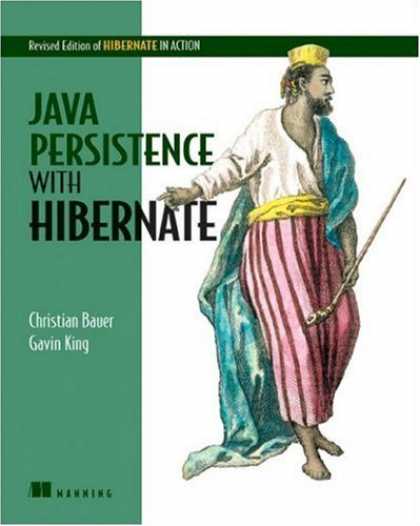
Java Persistence with Hibernate
Java Persistence with Hibernate is considerably more than simply a second edition to Hibernate in Action. It provides a comprehensive overview of all the capabilities of the Java Persistence API in addition to those of Hibernate 3, as well as a detailed comparative analysis of the two. It describes how Hibernate has been used to implement the Java Persistence standard, and how to leverage the Hibernate extensions to Java Persistence.
-- From the Forward by LINDA DEMICHIEL Specification Lead, Enterprise JavaBeans 3.0 and Java Persistence Sun Microsystems
Persistence, the ability of data to outlive an instance of a program, is central to modern applications. Hibernate, the most popular Java persistence tool, provides automatic and transparent object/relational mapping so it's a snap to work with SQL databases in Java applications. Hibernate conforms to the new EJB 3.0 and Java Persistence 1.0 standards.
Java Persistence with Hibernate explores Hibernate by developing an application that ties together hundreds of individual examples. You'll immediately dig into the rich programming model of Hibernate 3.2 and Java Persistence, working through queries, fetching strategies, caching, transactions, conversations, and more. You'll also appreciate the well-illustrated discussion of best practices in database design, object/relational mapping, and optimization techniques.
In this 2nd edition of Manning's bestselling Hibernate in Action, authors Christian Bauer and Gavin King -- the founder of the Hibernate project -- cover Hibernate 3.2 in detail along with the EJB 3.0 and Java Persistence 1.0 standards.
Beginning Hibernate: From Novice to Professional (Beginning: from Novice to Professional)
Beginning Hibernate is ideal if youre experienced in Java with databases (the traditional, or "connected," approach), but are new to open source lightweight Hibernatethe most popular de facto object-relational mapping and database-oriented application development framework. This book packs in brand new information about the latest release of the Hibernate 3.2.x persistence layer and provides a clear introduction to the current standard for object-relational persistence in Java.
Experienced author Dave Minter and contributor Jeff Linwood provide more in-depth examples than any other books for Hibernate beginners. The authors also present material in a lively, example-based mannernot in a dry, theoretical, hard-to-read fashion. And since the book keeps its focus on Hibernate without wasting time on nonessential third-party tools, youll be able to immediately start building transaction-based engines and applications.
Advanced Java 2 Platform How to Program (JDK 1.3, J2EE 1.2) 2001
A book for experienced Java programmers who want to build robust, scalable, distributed Web and enterprise applications. Detailed coverage of XML programming with Java, including DTDs, DOM, SAX, and XSL. Softcover. CD-ROM included.
Sams Teach Yourself J2Ee in 21 Days: With Ejb, Jsp, Servlets, Jndi, Jdbc, and Xml (Sams Teach Yourself...in 21 Days)
J2EE has become required knowledge for any serious Java developer, but learning this large and complex specification requires a substantial investment of time and energy. Sams Teach Yourself J2EE in 21 Days presents the enterprise Java architecture in accessible, easy-to-comprehend lessons, describing how each J2EE tool solves the challenges of n-Tier development. Using the architecture as a roadmap, following chapters describe Enterprise JavaBeans (EJB), JavaServer Pages (JSP), servlets, and more, giving readers a full understanding of J2EE development.
Further chapters cover the role of XML, custom JSP tags, and how Java Connectors allow J2EE applications to interact with legacy and non-Java systems. The book finishes with sample applications that put all the pieces together, including an example using J2EE to create Web Services. Along the way, every concept is illustrated with practical, real-world examples to ensure understanding by Java students as well as experts.
Core J2EE Patterns: Best Practices and Design Strategies
Sun Microsystems' Java 2 Platform, Enterprise Edition (J2EE) has become the platform of choice for Web-centric distributed enterprise application development. Expert consultants from the Sun Java Center have been helping customers build J2EE-based solutions since the earliest days of the technology, focusing primarily on up-front design and architecture. Along the way, they've identified powerful J2EE design patterns that lead to applications with superior performance, scalability, and robustness. This book brings those design patterns together, sharing Sun's best practices for development with Java Server Pages (JSP), Servlets, EJB, and other J2EE technologies. It presents a complete catalog of J2EE patterns encapsulating proven and recommended designs for common J2EE-related problems, organized into presentation tier, business tier and integration tier solutions. Presentation tier patterns describe solutions involving JSP and servlets; business tier patterns describe solutions involving EJB; and integration tier patterns describe solutions involving JDBC and Java Messaging Service (JMS). The book also identifies bad practices to be avoided. Finally, it presents an end-to-end multi-tier case study covering every stage of enterprise development.
JDBC Metadata, MySQL, and Oracle Recipes: A Problem-Solution Approach (Expert's Voice in Java)
JDBC Metadata, MySQL, and Oracle Recipes is the only book that focuses on metadata or annotation-based code recipes for JDBC API for use with Oracle and MySQL. It continues where the authors other book, JDBC Recipes: A Problem-Solution Approach, leaves off.
This new edition is also a Java EE 5-compliant book, perfect for lightweight Java database development. And it provides cut-and-paste code templates that can be immediately customized and applied in each developers application development.
Java Database Programming Bible
Java Database Bible is a comprehensive approach to learning how to develop and implement a professional level Java 2 database program using the Java database connection API (JDBC 3.0).
Includes an introduction to relational databases and designing database applications; covers interacting with a relational database using a Java program; and shows how to create and work with XML data storage using a Java program.
Subscribe to:
Posts (Atom)